Thursday, June 20, 2013

India House: Home of Artery-Clogging Goodness

A couple weeks ago I went to India House, a restaurant in downtown Chicago. I'm so predictable that of course I ordered baingan bharta (the creamy, smoky eggplant dish I have made in the past, accompanied by a co-chef who is sadly also past history).

Regarding this dish: a good friend of mine, Lana, sent me photos of her own chana masala and baingan bharta, based on the recipe provided in the blog. Her char-roasted eggplants look amazing. Thanks, Lana!


Baingan bharta is usually creamy and buttery. The way India House makes it takes creaminess to a new level, such that I alternated between gobbling it up like a rabid beast and clutching my stomach with pain.

A series of delicious dishes, with eggplant in the middle, all of which are basically the same color for some reason.

Don't forget the chutneys!

You can see the ghee pooling on the surface.

Overall, I would say that this bharta is totally delicious, but so rich that you can only eat a small amount. If I ate any more than that, I felt similar to the time I recklessly ordered a slice of cake AND a milkshake in a diner -- that is to say, disgusting.

Finally, as long as I'm on the topic of Indian food, I'd like to share the exciting news:

I just fermented stuff for the first time! AND I'M STILL ALIVE!

I made Indian lime-pickle from scratch, and it turned out great. Wedges of lime with vinegar, turmeric, mango powder, and tons of salt sat on the countertop for five weeks. Then I mixed it with spices and oil in a pan and voila!


The fermented limes with oil and spices, briefly cooked on the stovetop.

Let it sit for a few more days, and it's ready to eat! Delicious!

I made an Indian dinner to accompany my pickle: rasaam soup and garbanzo-pea-sweet-potato stew, along with rice and yogurt.

A feast! But there's not an eggplant in sight, so this is clearly a lengthy non-sequitur.

And with that, I'm going to Germany. So long, farewell, aufwiedersehen, goodnight!

Chillin and Grillin

Madness. Sheer madness.

This is a fairly accurate description of my life in the past few months, which explains the dearth of eggplant entries for the last long period. It's not as though I have more than about five regular readers, though, so the cumulative disappointment must be pretty minimal.

While I haven't been posting lately, I HAVE been accumulating photos. Not only this, I'm departing for Germany and Austria this Monday (AAAAAUGH so many preparations), and thus the time is now to generate a massive Aubergenius photo-dump. It remains to be seen whether Germany and Austria contain notable eggplants, and whether blog posts will appear over the course of my trip.

DID YOU KNOW?
It's grilling season.

I myself don't have a grill, and therefore grilled my first eggplants a few weeks ago using a friend's barbecue.

I was excited to grill these little baby eggplants.  They're just so cute.

 Unfortunately, grilling does in fact involve a learning curve. I started by grilling these various skewers, slabs of zucchini, barbecue-marinated tempeh, and eggplants doused in what I thought was a generous amount of olive oil. It turns out, however, that it's NEVER enough oil. The eggplants turned out rubbery and spongy, even after they'd grilled to the point of char, and the few that tasted good were the ones from the bottom of the bowl. Later on I tried slathering a few with barbecue sauce, but they were equally disappointing.


Not only that, but the slices were so thin that we lost about half of them through the grate in an attempt to turn them over. (We didn't have tongs, i.e., the meat-eaters got meat-juices on them and we had to use a spatula instead. Whooops.)

Suffice it to say that I need more grilling practice. But I think that they would have turned out perfectly if I had used enough oil.

More posts a-comin' up!

Sunday, March 10, 2013

Baba Ghanoush (Finally!)

Friends, here it is. The long-awaited and oft-requested baba ghanoush post.


Take a moment to remember the first time you ever tried baba ghanoush. (And if you haven't, you will, shortly after reading this post.) You're seated in your favorite local Middle-Eastern restaurant, with hot pitas and a pool of paprika-sprinkled hummus before you. Over in the corner lurks a slightly chunkier, translucent-looking beige spread. You dip in your pita, observe that it tastes practically the same (and yet not quite as good) as hummus, and shrug it off as yet another lemony Middle-Eastern spread.

There is something wrong with this picture. Baba ghanoush, as it is often made, has all the same ingredients as hummus, with eggplant substituted for chickpeas:  tahini, lemon, garlic, parsley, cumin/paprika/cayenne, olive oil... No wonder the two taste practically the same.

Several years ago, my mother (who is a Middle-Eastern-cooking inspiration to all) came to a simple, yet liberating realization: baba ghanoush doesn't have to taste just like hummus.

Baba ghanoush, a large pile of white bean spread lurking in the wings.

The following recipe -- a Syrian variant with a powerful secret ingredient, pomegranate molasses -- tastes totally different and totally amazing. I have received nothing but rave reviews of this baba ever since my mother and I started making it when I was in high school. I don't think I have ever made it without being asked for the recipe.

So now, finally, it's time to share my coveted baba ghanoush with the world. BUT, one simple caveat: I never measure anything when I cook. I can only give approximate quantities, and I leave it up to your own discretion to season this baba ghanoush to taste. My primary advice is to go easy on the pomegranate molasses. It's strong stuff, and a teaspoon of it goes a long way. But if you put more or less tahini in your baba, it's simply more or less sesame-ey, so that's up to you.

Ingredients
2 medium/large eggplants
tahini (Middle-Eastern sesame paste)
olive oil
pomegranate molasses (available at Middle-Eastern and South-Asian groceries)
balsamic vinegar
1 clove garlic
smoked paprika
cumin
salt, pepper
fresh parsley or cilantro

There are several ways of preparing eggplants for baba ghanoush. Ideally, it should have a smoky taste, so the best way to prepare the eggplants is on the grill. I don't have a grill, so I've found other methods. Here are your options:
1) Grill until skin is charred and flesh is soft all the way through, yielding to a fork
2) Roast eggplant directly on the flame of a gas stove, rotating with tongs until flesh is soft, as seen above.
3) Halve eggplant and coat liberally with olive oil (including the skin). Place on a baking sheet and bake at 350° F until eggplants are soft all the way through and skin peels off easily, about 30 minutes.

Removing the skin after employing the baking method.

Once your eggplant is cooked, remove the skin and any large seed flaps from the inside of the eggplant (careful, however, not to remove too much of the usable flesh). If the eggplant is especially bitter when you taste it, squeeze the flesh with your hands to remove the bitter juice.

In a food processor or blender, combine eggplant, a few tablespoons (or more) tahini, a generous swoop of olive oil, a clove of garlic (chopped into bits to avoid un-blended chunks), a dash of balsamic vinegar, a dash of pomegranate molasses (careful! strong flavor!), spices, herbs and salt. Note that the smoked paprika adds to the smoky flavor that is ideal for baba ghanoush. If you do add cumin, go easy on it, since you don't want that flavor to dominate.

Blend all ingredients until smooth, taste, and adjust seasonings. If it's too tart/salty, add more tahini. If it's too bland, add more salt and possibly balsamic vinegar. If you don't taste any of the pomegranate, add a few drops more.

Caution: this baba ghanoush may blow your mind.

Saturday, December 29, 2012

Turkish-style Stuffed Eggplants


'Twas winter, and the slithy veg
Did whiffle in the tulgey store:
Tomatoes pale and kale unhale
Lead cooks to yearn for more.

Yet beamish eggplants, gloaming bright
More frumious than any foe
Are firm and frabjous, as they are
Imported in from Mexico.

One two! One two! And through and through
The vorpal blade went snicker-snack.
I halved them flat and stuffed them up
With lentils for a tasty sup.

***************


This particular meal -- which featured homemade Turkish lavash, kidney bean salad, olives and stuffed eggplants -- was inspired by recipes in Sarah Beattie's Vegetarian 30 Minute Turkish Cookbook (London: Thorsons, 1998).

Tea-towel and tea-lights in an attempt to make my Ikea table look more Turkish. 

Note the phrasing "inspired by." I love the premise of this cookbook -- that vegetarian Turkish cuisine exists, that it can be prepared quickly, and that simple, fresh ingredients yield delicious food -- but the actual recipes are seriously misleading. First, the proportions in many of the recipes are way off. Secondly, many of the recipes take far longer than 30 minutes, even for an experienced cook.

Kidney beans, carrots, and potatoes marinated in lemony tomato sauce.

For example, Beattie's bean salad recipe calls for half as many beans and twice as much lemon as I used. Mine nonetheless tastes extremely lemony, on the verge of too acerbic. Also, the recipe calls for one carrot and one potato, diced and cooked in the pan until soft. To actually soften carrots and potatoes in the pan, even when relatively finely cubed, takes a long time -- and in my haste to make the 30-minute deadline, a.k.a. my growl-stomached impatience to finish the dish, my carrots and potatoes came out undercooked, despite frying them on high for 20 minutes. Crunchy potatoes are the worst. And in both recipes (the bean salad and eggplants), I used 1/2 and 1/4 (respectively) the onions called for the recipe, and it was more than enough. Who needs 2 diced onions for enough eggplant to serve 4 people? That's half an onion per capita. WTF (= what the food)??

Of course, my preparation of this meal was not aided by the unexpected discovery that MY OVEN IS BROKEN. I was just about to put in the eggplants when I realized that it smelled strongly of gas and was cold as a cucumber inside. Good thing I didn't blow myself up, or Sylvia Plath myself; but determined not to give up, I prepared the entire dinner on the stovetop, primarily in a wok, and it took forever.

So overall, a delicious meal that took way longer than it should have. If you use an oven as the recipe specifies, you'll be in good shape.

Rather than reproducing the author's recipe verbatim, here's my own modified recipe. The lentil filling makes way too much, but this way you can have the leftovers as a tasty lentil stew. Or you can cut the ingredients in 1/4 if you want just enough for the eggplants.


Turkish-style Lentil Stuffed Eggplants

Ingredients
4-5 baby eggplants (the kind that are ca. 5 inches long)
1 cup dried lentils, rinsed (recipe calls for 1 can lentils, which saves cooking time but yields less flavorful filling)
Enough veggie broth to cover lentils plus 2 inches
1 14oz can diced tomatoes
1/2 onion, diced
2 cloves garlic, minced
Cumin, salt, pepper to taste
Chopped parsley
Olive oil

Method
Begin by preparing the lentil filling. Brown lentils take a while to cook, and the longer this filling simmers, the tastier it becomes. Thus multitask by making something else -- salad, lavash, etc. -- while the filling is cooking.

Fry the onion and cumin in olive oil, then add the lentils, broth (or salted water), and tomatoes (including juice) and bring to a boil. Reduce to a simmer, cover, and cook until lentils are soft, stirring occasionally. Once lentils are soft, turn off heat and add salt/pepper to taste, then stir in chopped parsley.


When the lentils are about 3/4 done (a bit chewy/crunchy, but softened somewhat), prepare the eggplants. This recipe calls for baby eggplants, which cook quickly and are kind of adorable.


After washing eggplants, cut off stems and halve lengthwise. Coat generously in olive oil and bake in oven at 350° F. Remove when eggplants are soft all the way through. 

(But of course, since my oven was broken, I cooked them a few at a time in the wok. It was a pain.)


Scoop out eggplant flesh, careful not to damage the exterior shell. Chop flesh, mix with enough lentil filling to stuff eggplants, and pile into the eggplant shells.


At this stage, the eggplants are finished. If you prefer vegetarian to vegan, you can sprinkle cheese on top, such as the parmesan seen in my final photo. Before I knew my oven was broken, I was planning to crumble goat cheese on top, then pop them back in the oven. 


These eggplants are delicious with any sort of pita, flatbread, lavash, or crusty bread. The Turkish lavash I made came from this blog and it turned out well. Oil-cured olives are also a tasty accompaniment.


Overall, a delicious meal. I'll include the (modified) bean salad recipe below, for those who wish to duplicate it in its entirety. 

Marinated Kidney Bean Salad

Ingredients
1/2 onion, diced
1 carrot, diced
1 waxy potato, diced
2 cups Italian strained tomatoes
2 cloves garlic
2 14oz cans red kidney beans, rinsed and drained
1 tbsp sugar
1 lemon, juiced
Chopped parsley
Salt to taste

Method
Fry the carrot and potato in olive oil until mostly soft. Add onion towards the end of this process, since it takes less time than the other veggies. When onion is translucent, add garlic, beans, tomatoes, and sugar. Simmer for 5-10 minutes. Remove from heat, salt to taste, and add lemon juice. Top with parsley and refrigerate overnight for marinated goodness, or eat warm with bread.


Uh... yum.


Monday, December 17, 2012

Chinese Eggplant! oh, wait... FAIL

After my recent trip to Lao Hunan in Chicago's Chinatown, I decided to head back there with some friends and try more items on the menu. The result was very attractive on the plate:


 ... but INEDIBLE. One of the rare occasions I've had to send something back, which felt strangely dangerous given the Mao-themed environs.

The dish was Crispy Eggplant Hunan Style, with battered and deep-fried pieces of eggplant tossed with peppers (both fresh and dried). Yet the batter was so unbelievably salty that we found ourselves cringing as we attempted to eat the stuff. As a substitute, they brought a rendition of the eggplant in plum sauce (pictured in my last Lao Hunan entry) that was tasty, but this time there was an oil slick about an inch wide pooling around the edge of the plate. This is often a problem in Chinatown, I've found -- food is too salty, too greasy, too spicy. And the Caucasian connoisseur inevitably asks his/herself: is it supposed to be that way? Do Chinese people eat it this way? AM I GOING CRAZY, OR IS IT THE WORLD AROUND ME??

In the end, we decided that people from Hunan likely have similar tastebuds and the salt-lick eggplant was probably a mistake.

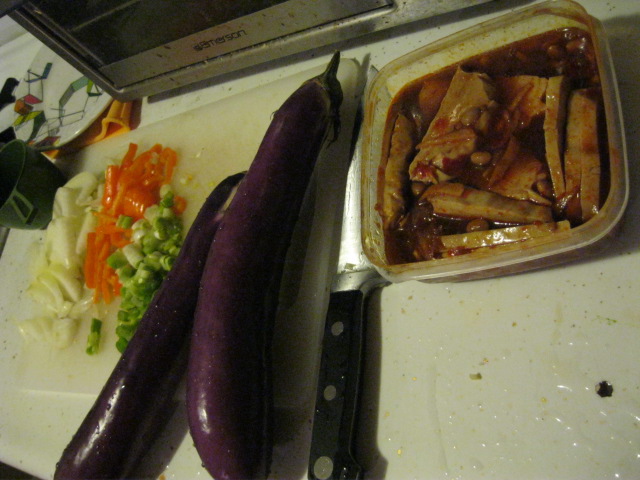
Meanwhile, I bought some Chinese eggplants, unflavored seitan, and Taiwanese chili-fermented-bean paste while in Chinatown. I decided to make a stir-fry, which unfortunately was also one big FAIL. But like the above, it looked pretty:


I crafted this dish with the hypothesis that Chinese food in restaurants tastes better because it has more oil, salt, and sugar than homemade. Thus, I made a stir fry my usual way, but added considerably more salt and sugar to the sauce. Lo and behold, it tasted like my usual sub-par stir fry, only sweeter and saltier. So much for that hypothesis.

My only consolation was that the seitan itself turned out well. I soaked it overnight in the chili sauce, along with sticks of chopped ginger and large pieces of garlic. It gained a lot of flavor and softened up in the pan.

I think this dish would have turned out just fine had the sauce tasted better. The fermented bean chili paste has a weird flavor that leads me to suspect that the jar is several decades old. I deny any blame for the dish turning out crappily.


Seitan a-soakin' and eggplants a-sittin'.

 First I fried the eggplants in a bunch of vegetable oil.

Until they were cooked through and lightly browned. Still spongy in this photo.

Then I sauteed the marinated seitan.

I added onions, scallions, and peppers to the mix. I probably should have added the onions earlier, or cooked them by themselves and then added the seitan. They were a little underdone, contributing further to this dish's crappiness.
(Three Crappiness?)

I added the eggplant back in.

Then added the sauce and cooked until it looked marginally appetizing.

Well, that's it for my eggplant exploits of late. Fail and more fail. Hopefully my next entry will involve actual cooking success, as is expected on a cooking blog. Geez.


Tuesday, November 20, 2012

Indian baingan bartha

I've never been superb at Indian cooking -- it requires a certain degree of skill, training, and long cooking times that I've never been able to achieve. But that doesn't stop me from trying, and this time the result was a tasty spread of Indian classics: chana masala (tomato chickpeas), rasaam soup (tamarind sweet-and-sour), and of course baingan bharta (smoky eggplant stew).


We (as in me and co-chef Josh) ended up using this recipe for the baingan bharta. It turned out well -- my only rookie mistake was not cooking the eggplant enough before it went into the pan, with the result that the dish was more chunky and less creamy than it should be. 

We started by roasting the eggplants over the flame on my gas stove, then stuck them in the oven for a while, and finally peeled off the skin and mashed the flesh.

Coarsely mashed eggplant.

Other tasty ingredients ready to go.
Next we sauteed onions, garlic, ginger, and spices in oil, then added tomatoes and let the mixture cook down. 

Flavorful components break down in oil or butter: a typical step in Indian dishes.
Then we added the eggplant to the mix, cooked it down for a while and towards the end of the process, added green peas (not in the recipe, but a yummy addition).

Yours truly adds the eggplant to the mixture.

Co-chef Josh gives the goop a stir.

Simmering in the pan.
Note that photos are blurry because my kitchen is SO INSANELY DARK ALL THE TIME. Apologies.

Chana masala cooking alongside.

Lycopene goodness, again, as usual. Do I ever cook anything without  tomatoes?

At the end of the cooking process, we added chopped cilantro and lots of salt. Without the salt, it tasted pretty bland -- so don't skimp on the sodium!


The end result up close.


The oilier, the tastier!

Don't forget the flatbread and rice!

Naturally, the perfect addition to an eggplant-ful meal is eggplant relish, a spicy-sweet-sticky paste that is delicious with rice or bread and yogurt. Lime pickle is also a delicious condiment on the side.


Om-nomming our meal: a candid rather than posed portrait.